
A treadmill belt looks like the safest place to try running without shoes. It’s flat, indoors, and free of the gravel and glass that make outdoor barefoot running feel risky.
That’s exactly what makes it deceptive.
The belt removes gravel, but it introduces its own hazards, and most of them show up on the sole of your foot, not the ground.
Here’s what actually happens when bare skin meets a moving belt, and how to try it without paying for it in blisters.
What a treadmill takes away from barefoot running
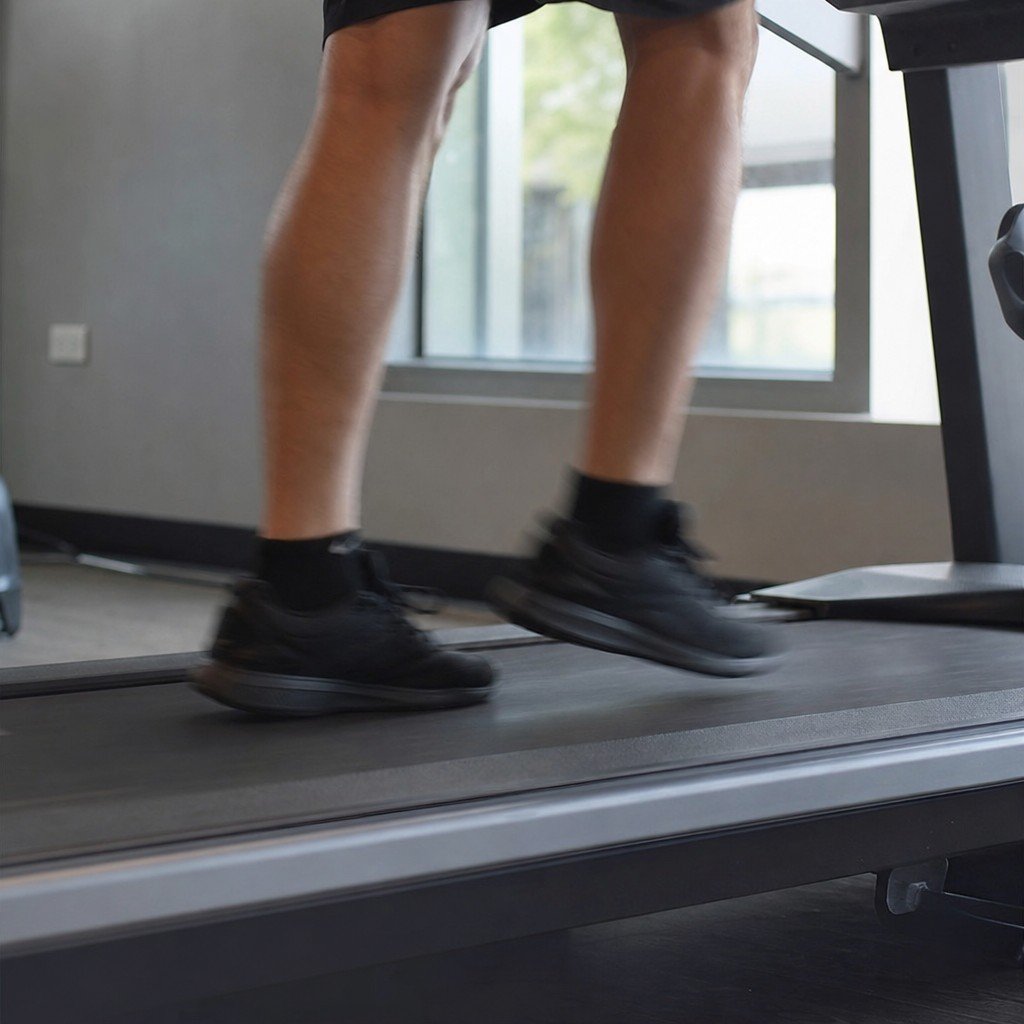
Most of the appeal of barefoot running outdoors is the feedback.
Grass, packed dirt, and pavement all give your foot slightly different information on every step.
A treadmill belt gives you one texture, over and over, at a pace it sets rather than you.
That’s a narrower kind of ground-feel than an actual trail or sidewalk offers.
You still get useful input: how your foot lands, whether you’re landing hard, where your weight sits. You just get less variety than running on different surfaces provides outdoors.
The belt itself is the real hazard
Shoes usually protect you from two things: the ground, and the surface you’re standing on.
On a treadmill, the ground problem disappears, but the surface problem doesn’t.
Belt friction builds heat, and heat plus repeated contact is what raises a hot spot into a blister.
A slip or a dragged foot against a moving belt can also cause a friction burn. That’s a different injury than the kind bare feet usually get outdoors.
A few other things to know before you step on:
- Treadmill belts pick up static charge, and bare skin against it can produce a small shock.
- Gym equipment gets used by a lot of people barefoot and in socks. Basic foot hygiene (dry feet, checking for cuts) matters more here than on your own floor at home.
- Traction is different from a road or track. A sweaty sole can slide more than a shod foot would.
None of that means it’s a bad idea.
It means the risks are different from the ones you’d expect outdoors, so the precautions need to match.
Barefoot, socks, or minimalist shoes on a belt
Minimalist shoes are usually the more comfortable choice on a treadmill, not the more cautious one.
They add a thin layer between skin and belt, which cuts down on both heat transfer and the static-shock issue.
Grip socks sit in the middle. They reduce direct skin contact but don’t add much cushioning, and a sock with no grip pattern can actually slide more than bare skin does.
Fully barefoot on the belt is workable in short doses. It asks more of your skin in a shorter time than being barefoot on a trail would.
Remember that minimalist shoes and fully barefoot are points on one path, not rival camps.
Trying the treadmill in minimalist shoes first, then bare feet later, is a reasonable way to test the belt. It does that without testing your skin’s limits on day one.
The belt changes how you run, not just what’s under you
It isn’t only the surface that’s different.
Research comparing treadmill and overground running has found the two are largely similar in basic stride mechanics, but not identical.
A 2019 systematic review and meta-analysis in Sports Medicine, covering 33 studies, found ground contact time ran slightly longer on a treadmill than overground. The review’s authors noted the difference was small enough that it may not matter much in practice. Stride length and stride frequency showed no consistent difference across studies.
The practical takeaway is simpler than the numbers: the belt sets your cadence for you. Your stride adapts to it rather than the other way around.
That’s a different feeling from barefoot running outdoors, where you set the pace and the ground responds.
Expect your first barefoot treadmill runs to feel a little unfamiliar for that reason.
It’s the belt, not a sign you’re doing it wrong.
How to actually try it
Start with walking, not running.
Give your skin and your balance a chance to get used to belt contact before you add speed.
Too much, too soon is the mistake almost everyone makes.
A moving belt makes “too much” arrive faster than solid ground does. A hot spot can turn into a blister within a single session if you push a long barefoot run right away.
A sensible first attempt:
- Try five to ten minutes barefoot or in minimalist shoes, at an easy walk or jog.
- Stop and check your soles partway through. Redness or warmth in one spot is your cue to end the session there.
- Keep a towel nearby. Sweaty feet slide more, and a quick wipe helps traction.
- Increase time gradually across sessions, the same way you would with any beginner barefoot running plan.
If you’re newer to barefoot running generally, a slower transition timeline still applies indoors.
The belt doesn’t skip that process. It just runs it under different conditions.
What to watch for
A hot, tender patch on the ball of the foot or heel is different from ordinary early soreness.
Treat it as a stop sign for that session, not something to push past.
Sharp or joint-deep pain is a stop sign, not something to push through, whether it shows up on a treadmill or a trail.
The same warning signs that apply to any barefoot running injury apply here.
Blisters and minor friction marks are common early on and usually settle once you build a bit of tolerance.
Redness that persists, or any break in the skin that looks infected, is a reason to see a clinician rather than keep running on it.
Who it actually suits
It suits testing the waters before going outdoors, not chasing the full outdoor barefoot experience.
Barefoot treadmill running suits someone who wants a controlled, low-hazard way to test barefoot running before taking it outdoors.
It’s predictable, indoors, and easy to stop the moment something feels off.
It suits less well anyone chasing the full outdoor barefoot experience.
The ground-feel, the surface variety, and the pacing control you set yourself are all part of what people are usually looking for. A treadmill offers less of all three.
If you have diabetes, neuropathy, or any condition that affects feeling or healing in your feet, talk to a clinician before trying barefoot treadmill sessions.
This is general information, not medical advice, and foot skin problems in particular deserve a professional look rather than a guess from an article.