
Most people who try barefoot running make the same mistake. They do too much, too soon.
The barefoot part rarely causes the injury. The rushing does. Your feet and lower legs can adapt to running without cushioning, but they adapt slowly, and the first few weeks are where things go wrong.
This is a plain starting guide: what barefoot running asks of your body, how to begin, and the warning signs that mean stop.
This is general information, not medical advice. If you have a foot problem, an injury, or any condition affecting your feet or legs, check with a doctor or physical therapist before you start.
What barefoot running actually changes
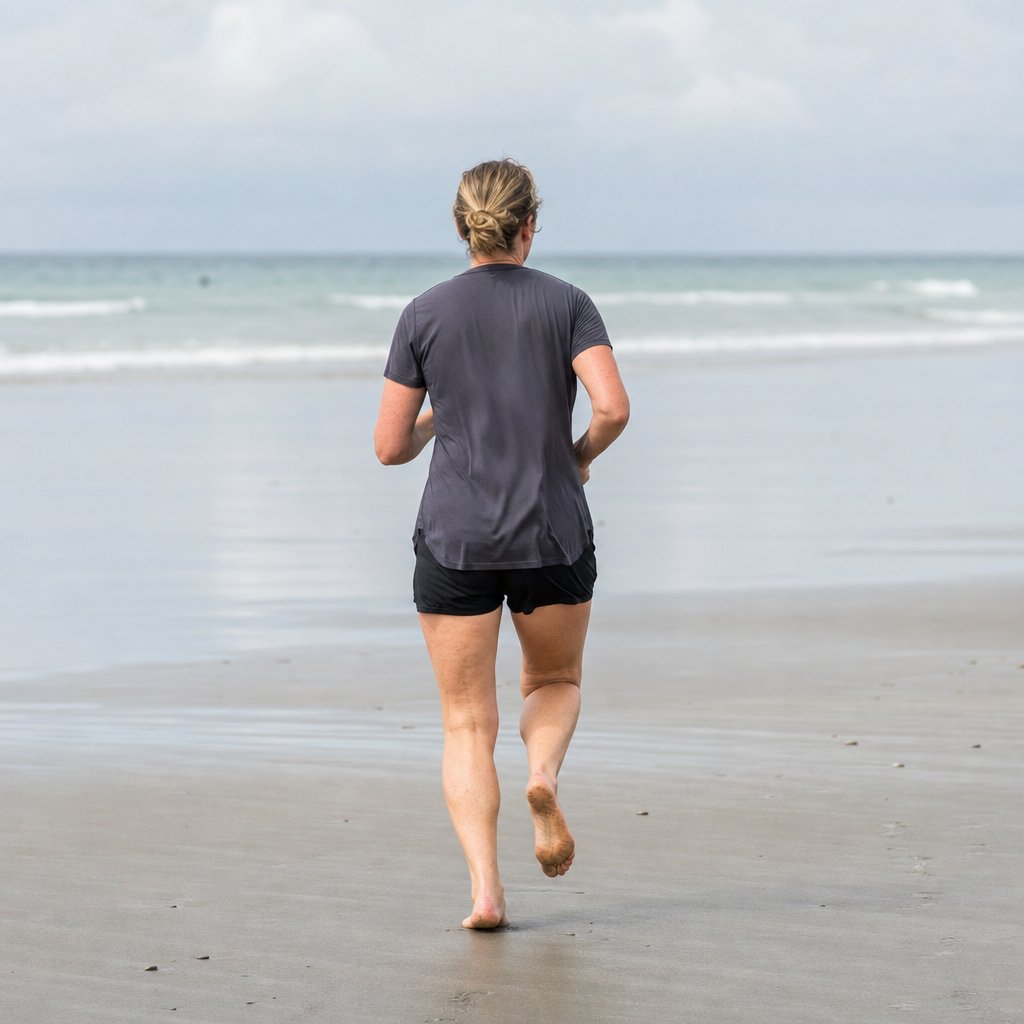
Running barefoot is built on two things:
- You land on the front or middle of your foot, not the heel.
- You keep an upright posture and a short, light stride.
That is the whole mechanical idea. The interesting part is why it matters.
When a runner in cushioned shoes lands heel-first, the foot meets the ground ahead of the body and creates a sharp spike of force. Researchers call this an impact transient. A Harvard team led by Daniel Lieberman documented it in a 2010 study in Nature: habitual barefoot runners tend to land on the forefoot and largely avoid that spike, while shod heel-strikers take it on every step.
Going barefoot does not fix your form on its own. It removes the cushioning that was hiding it.
Start by actually going barefoot
The best way to learn the technique is to run barefoot. Not in minimalist shoes at first. Bare feet.
Bare skin forces you to run softly. Even a thin shoe hides sharp objects and lets a beginner pound the ground without noticing. The more your soles feel the surface, the more naturally you lighten your step.
So begin with short, easy barefoot stretches and pay attention to what your feet tell you.
Add it in small doses
A sensible guideline is to start with only about ten percent of your usual running barefoot, then increase by roughly ten percent a week.
If you normally run five miles, that is about half a mile barefoot for the first couple of weeks.
The number matters less than the principle. Let your feet set the pace of the change, not your enthusiasm. Your calves, Achilles tendons and the small muscles of the foot all take on more load once you stop heel-striking, and they need time to catch up.
Pick smooth surfaces first
Start on smooth, predictable ground before you take on rough trails.
Asphalt sounds harsh, but a smooth paved path is good for learning, because nothing underfoot distracts you from your stride. You can keep your head up and focus on landing lightly.
A dirt path is the harder test. The soles take more at first, until you learn to use your legs to soften each step. Build up to it.
An indoor option is a treadmill. The belt is smooth and predictable, though it brings a few quirks of its own, so it helps to know how barefoot running on a treadmill works before your first try.
How to start barefoot running, step by step
If you want the whole thing as a short checklist, here it is.
- Start on bare feet, not shoes. Bare skin teaches a soft landing faster than any minimalist shoe does.
- Run only about ten percent of your usual distance barefoot at first, and add roughly ten percent a week.
- Stay on smooth, predictable ground to begin with: a paved path or a treadmill, before dirt or trail.
- Land on the front or middle of your foot with a short, light, upright stride.
- Treat sharp or joint-deep pain as a stop sign, not a challenge to push through.
The rule that matters most: avoid pain
Pain is information.
Aching, tired calves and feet in the first weeks are common while everything adapts. That kind of soreness usually eases.
Sharp pain, or pain felt deep in a joint, is different. That is a stop sign, not something to push through. It can mean your technique is off, or that you are loading tissue that needs rest.
If running starts to hurt that way, change what you are doing. Shorten the run, soften the stride, or stop and rest. If the pain keeps coming back, see a clinician.
Where to go from here
Barefoot running is not a magic fix, and it is not a competition. Done patiently, it is a way to feel your stride and let your feet do more of the work they were built for.
If you are still weighing it up, read seven reasons people take up barefoot running and the minimalist running philosophy, which shows where minimalist shoes fit on the same path. For a low-pressure first try, International Barefoot Running Day is a friendly excuse to start.