
A rock that would barely register on pavement can roll an ankle on a trail. That’s the real difference between road and trail.
It changes everything about going barefoot or minimalist off pavement.
Most barefoot-running guides are written with smooth ground in mind: a track, a sidewalk, a stretch of packed dirt. Trails don’t offer that kind of consistency.
The ground changes with every step, and your feet have to change with it.
That doesn’t mean trails are off-limits.
It means the transition needs more caution, and a different set of tools, than the one that got you comfortable on the road.
Why trails are a different problem
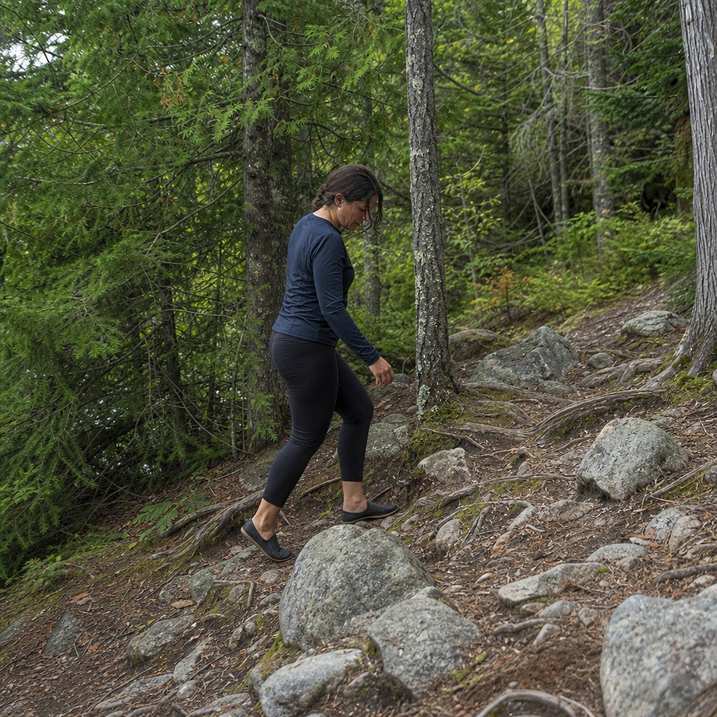
A trail asks your feet to solve a new puzzle on every stride. Roots, loose rock, mud, and camber shift under you in ways smooth pavement never does.
Uneven ground asks your feet and ankles for constant micro-adjustments to keep you balanced, and that demand climbs fast once the stabilizing muscles get tired.
A simple misstep on a rock or root is all it takes to roll an ankle inward.
Bare skin adds a second layer of exposure.
There’s no cushioned outsole between your foot and whatever is actually on the ground. That could be a sharp stone, broken glass at a trailhead, or thorny brush along a narrow path.
Loose footing and sharp debris are two separate hazards, and trail running combines them. Road running mostly deals with just one, and even then it’s forgiving pavement doing the work.
Why fully barefoot rarely makes sense here
Going fully barefoot on smooth, predictable ground has real support behind it.
Rough trail is a different case.
The skin on the sole of your foot can toughen with a careful transition over predictable terrain.
It can’t reliably shrug off a sharp rock edge or a hidden thorn, no matter how much conditioning you’ve done.
Sharp or joint-deep pain is a stop sign, not something to push through. A puncture wound or a deep bruise from unseen debris is exactly that kind of pain.
On trail, those hazards can hide under leaves, mud, or shadow until your foot is already on top of them.
That’s the practical case for some kind of sole between you and the ground once terrain gets rough.
It isn’t a verdict against barefoot running generally.
It’s a statement about a specific kind of surface.
Where a minimalist trail shoe earns its place
This is where minimalist shoes stop being optional and start being useful.
A thin, flexible sole keeps most of the ground feel that draws people to barefoot running. It also adds a layer between your skin and the sharpest hazards.
Trail terrain places its own demands on the feet and ankles: uneven surfaces, steep inclines, and unpredictable footing.
The repeated impact and twisting motion on that ground is what raises the risk of ankle sprains and stress fractures.
A minimalist trail shoe doesn’t erase that risk. It can reduce two specific things:
- Puncture and laceration risk from rocks, roots, and sharp debris underfoot.
- Some abrasion and bruising from repeated contact with hard, uneven surfaces.
What it typically won’t do is stop an ankle from rolling on a bad step.
No shoe fully solves that; footing, attention, and pace matter more than sole design for that particular risk.
Minimalist shoes and fully barefoot are points on one path, not rival camps.
On trail, most people will spend more time on the minimalist end of that path than they would on the road.
The protection-vs-ground-feel tradeoff
Every choice here trades one thing for another.
More sole means more protection and less feedback from the ground. Less sole means the reverse.
Ground feel is not just a sensation. It’s information: where a rock sits, whether the surface is loose, how much force you’re putting into a landing.
Thick cushioning muffles that feedback, which is part of the appeal of going minimal in the first place.
On trail, though, the information you’re giving up by going too minimal isn’t cosmetic.
It’s the early warning for exactly the hazards that cause the injuries above.
A useful way to think about it: the more unpredictable the trail, the more that sole is doing safety work, not just comfort work.
A smooth, packed fire road can tolerate less sole than a rocky singletrack with loose scree.
How to transition onto trails safely
Too much, too soon is the mistake almost everyone makes, and trail adds more ways to make it. A cautious build-out looks something like this:
- Start on smooth, packed paths, not technical singletrack. Crushed gravel or a well-maintained fire road is a reasonable first trail surface.
- Keep early distances short. Fatigue is when footing errors happen, so the goal early on is time on varied ground, not mileage.
- Add technical terrain gradually. Roots, rock gardens, and loose scree come later, once your feet and attention have adjusted to the basics of uneven ground.
- Watch fatigue, not just distance. A tired stride lands less precisely, and that’s when a foot finds the one rock it shouldn’t.
- Run in daylight when you’re still learning a trail. Hidden hazards are a bigger issue on trail than on road, and light is the simplest defense.
Start on smooth, predictable surfaces before you take on rough ground.
That principle doesn’t stop applying once you’re comfortable on pavement. It just moves up a level, from “flat concrete versus grass” to “packed path versus technical singletrack.”
Let your feet set the pace of the change, not your enthusiasm.
A new trail runner who feels strong on packed gravel is not automatically ready for a rocky descent. The two surfaces ask very different things of the same feet.
Injury cautions specific to uneven terrain
Trail-specific injuries look different from the ones road runners usually manage.
A 2016 cohort study of Dutch trail runners found ankle sprains accounted for about 7 percent of all reported injuries. Achilles tendon problems and calf strains were also common, according to the study’s published data.
Three specific risks are worth knowing before you go:
Ankle rolls. A misstep on a hidden rock or root is the classic trail injury. Watching the ground a few strides ahead, rather than right underfoot, gives you more reaction time.
Bruising and impact. Repeated contact with hard, irregular surfaces can bruise the sole over time, especially early in a transition when the tissue hasn’t toughened yet.
Punctures from hidden debris. Leaves, mud, and shadow can all hide sharp objects. This is the clearest argument for some sole on technical or unfamiliar trail, even for someone otherwise comfortable barefoot.
If any of these produce sharp pain, swelling that doesn’t settle, or deep joint pain, that’s a question for a clinician.
It doesn’t belong in a training log.
This is general information, not medical advice, and trail-specific injuries are exactly the kind a physical therapist or podiatrist can assess properly.
Getting equipped without overbuying
You don’t need a specialized shoe wall to start.
Most people moving onto trail already have one of two things: bare feet, or an entry-level minimalist shoe from road use.
If you’re using the same minimalist shoe you wear on the road, check the tread and sole thickness before committing to technical terrain.
A road-oriented minimalist shoe with a smooth sole won’t grip loose rock the way a trail-specific version will.
For shoe basics, how to choose a minimalist shoe covers what actually defines “minimalist” beyond marketing language, which matters more on trail than on road.
Runners still working out the broader transition timeline may also find the guide to how long transitions typically take useful. Trail adds time to an already gradual process.
Gear is only part of the picture.
If the ankle-roll, bruise, or puncture risks above don’t resolve on their own, that’s worth a closer look.
For that, the rundown of common barefoot running injuries is a reasonable starting point for telling normal soreness from a genuine warning sign. Use it to decide whether to see someone.
The short version
Trails combine two hazards road running doesn’t: unpredictable footing and hidden sharp debris.
That combination is why fully barefoot rarely makes sense on rough trail, even for someone well adapted to smooth ground.
A minimalist trail shoe is usually the better tool for the job.
It keeps most of the ground feel that makes barefoot running appealing, while adding a thin layer against the specific dangers trail terrain introduces.
Build slowly, start smooth, and let the trail get technical only after your feet have proven they’re ready for it.
That’s not a compromise on the barefoot approach. It’s the same patience the whole transition has always asked for, applied to rougher ground.