
A shoe with five separate toe pockets looks strange the first time you see it.
That’s the point.
Vibram FiveFingers were built to let each toe move and grip the ground on its own. That’s how it would move if you had no shoe on at all.
They’re one of the most recognizable minimalist shoes ever made.
They’re also one of the most misunderstood.
FiveFingers sit closer to fully barefoot than almost anything else you can buy, and that changes how you need to approach them.
Here’s what they actually are, who tends to do well in them, and where people get the transition wrong.
What a FiveFinger shoe actually is
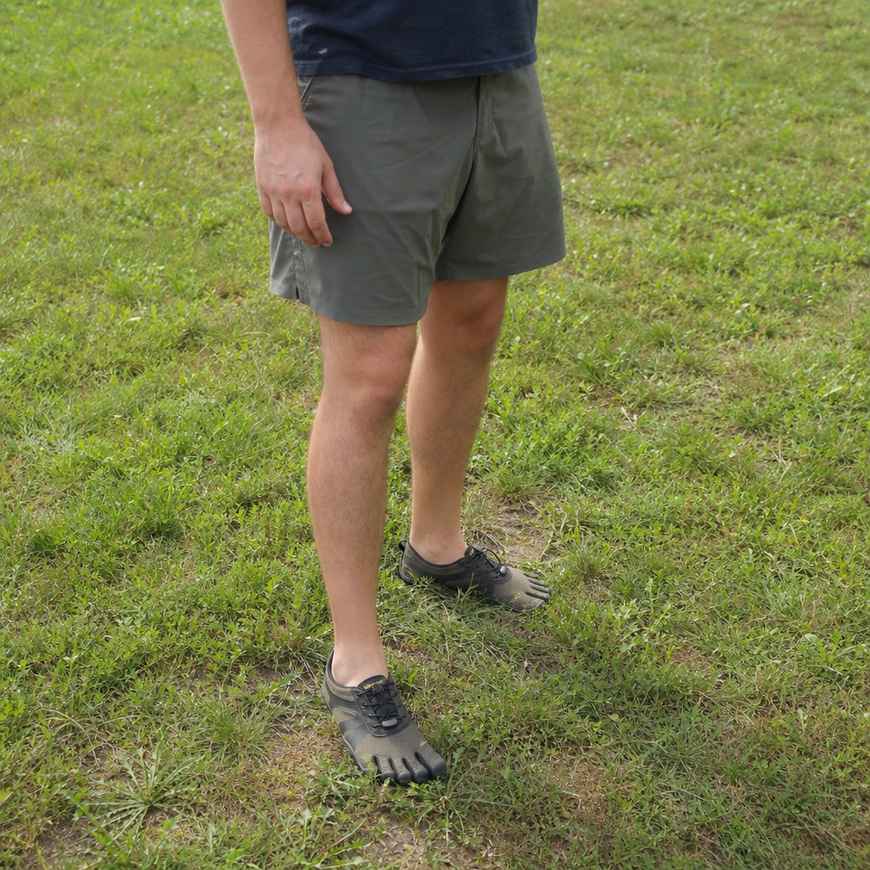
Strip away the toe pockets and the idea is simple.
A thin, flexible sole with almost no cushioning and no raised heel.
That sole is thin enough to feel texture and temperature through it.
There’s little to no arch support and no motion-control features of the kind found in cushioned trainers.
The individual toe pockets are the real signature.
They let toes splay and grip independently, closer to how a bare foot moves than any other shoe style manages.
The idea behind that design is straightforward: let the foot do the work a cushioned shoe usually does for it.
Whether that pays off depends heavily on how you use them, not on the shoe alone.
The health claims that got overreached
FiveFingers were marketed for years on the promise that they’d strengthen your feet and cut your injury risk.
That promise ended up in court.
Vibram paid $3.75 million in 2014 to settle a lawsuit over exactly those claims. Our full look at what the research actually says about minimalist shoes covers that case in detail.
Short version: the shoes can change how you run, but the guarantees were never as settled as the ads made them sound.
That doesn’t make FiveFingers a bad shoe.
It makes the marketing worth ignoring in favor of what the shoe actually does.
Who tends to do well in them
FiveFingers suit a specific kind of runner more than a general one.
People who already run on soft, predictable, familiar routes tend to adapt best.
A known stretch of park path or a treadmill beats an unfamiliar trail for a first few weeks.
They also tend to suit runners who are patient by nature, or willing to become patient for this.
The shoe gives almost no cushioning to hide a rushed transition.
They suit less well:
- Runners chasing mileage goals on a fixed schedule
- Anyone with an active foot or ankle injury
- People who mostly run on gravel, broken pavement, or unpredictable urban ground early on
If you have diabetes, neuropathy, or any condition that affects sensation in your feet, talk to a podiatrist before trying minimal footwear at all.
This is general information, not medical advice, and reduced sensation changes the risk calculation.
Why the transition needs extra care here
Most minimalist shoes ease you toward ground feel.
FiveFingers hand you most of it immediately.
Too much, too soon is the mistake almost everyone makes with minimalist footwear, and FiveFingers make that mistake easier to fall into.
There’s less shoe standing between your effort and your tissue.
The clearest warning on this comes from FiveFingers specifically, not minimalist shoes in general. In a 2013 study at Brigham Young University, runners moved into FiveFingers over 10 weeks. They showed more bone-marrow swelling in their foot bones than runners who stayed in their regular shoes, the university reported.
That’s not a reason to avoid the shoe.
It’s a reason to move slower than 10 weeks.
The transition is where injuries happen, not barefoot running itself.
Calf and foot soreness in the first few weeks is expected.
Sharp pain, or anything that feels deep in a joint, is a stop sign, not something to push through. See a clinician if it doesn’t settle quickly.
The fit quirks people run into
FiveFingers fit differently than any running shoe most people have owned, and that trips a lot of first-time buyers.
Sizing runs by foot measurement, not your usual shoe size.
Toe length and width both matter more than they do in a rounded toe box. A size that “should” fit by your normal number often doesn’t.
A few things worth expecting:
- Toe pockets need to match your actual toe shape. A pocket that’s slightly short pinches; slightly long leaves dead space that rubs.
- Break-in is real. The sole and pockets soften with wear, and a pair that feels tight on day one may settle in over a few weeks.
- Socks matter more than they seem to. Toe socks exist mainly to solve blister points that ordinary socks create against individual toe seams.
Buying based on your everyday shoe size, without checking a foot-measurement chart first, is the single most common fit mistake.
Where they sit against other minimalist shoes and going fully barefoot
Minimalist shoes and fully barefoot are points on one path, not rival camps.
FiveFingers sit near the barefoot end of that path.
A standard minimalist trainer still has a full sole and a rounded toe box.
It gives up cushioning and drop, but keeps some structure between your foot and the ground.
FiveFingers give up almost all of that structure while keeping a thin layer against glass, gravel, and hot pavement.
If you’re weighing where to start, our comparison of barefoot versus minimalist shoes walks through that decision in more depth. Our transition timeline guide covers realistic pacing either way.
Fully barefoot gives you the most feedback and the least protection.
FiveFingers trade a small amount of that feedback for a shoe you can wear on more surfaces.
Neither is the “correct” endpoint.
Both ask the same thing of you: let your feet set the pace of the change, not your enthusiasm.
If you’re shopping around
Sizing varies enough between models and manufacturing runs that guessing your fit rarely works.
Fit and sizing vary noticeably between models and manufacturing runs.
Trying a pair on, or checking a detailed size chart against your own foot measurements, matters more here than with an ordinary running shoe.
If you want to see the range of styles and toe-pocket shapes available, you can compare Vibram FiveFingers shoes on Amazon. That makes it easier to decide which fit and coverage suit your feet and your usual running surface.
The honest starting point
FiveFingers aren’t a shortcut to stronger feet or fewer injuries.
They’re a tool that removes cushioning fast, which suits some runners and rushes others.
Start slow, on familiar ground, in the right size, and let soreness (not ambition) set your pace.
Handled that way, they can be a reasonable way into minimalist running.
Handled fast, they’re the same story Brigham Young University’s researchers already documented.